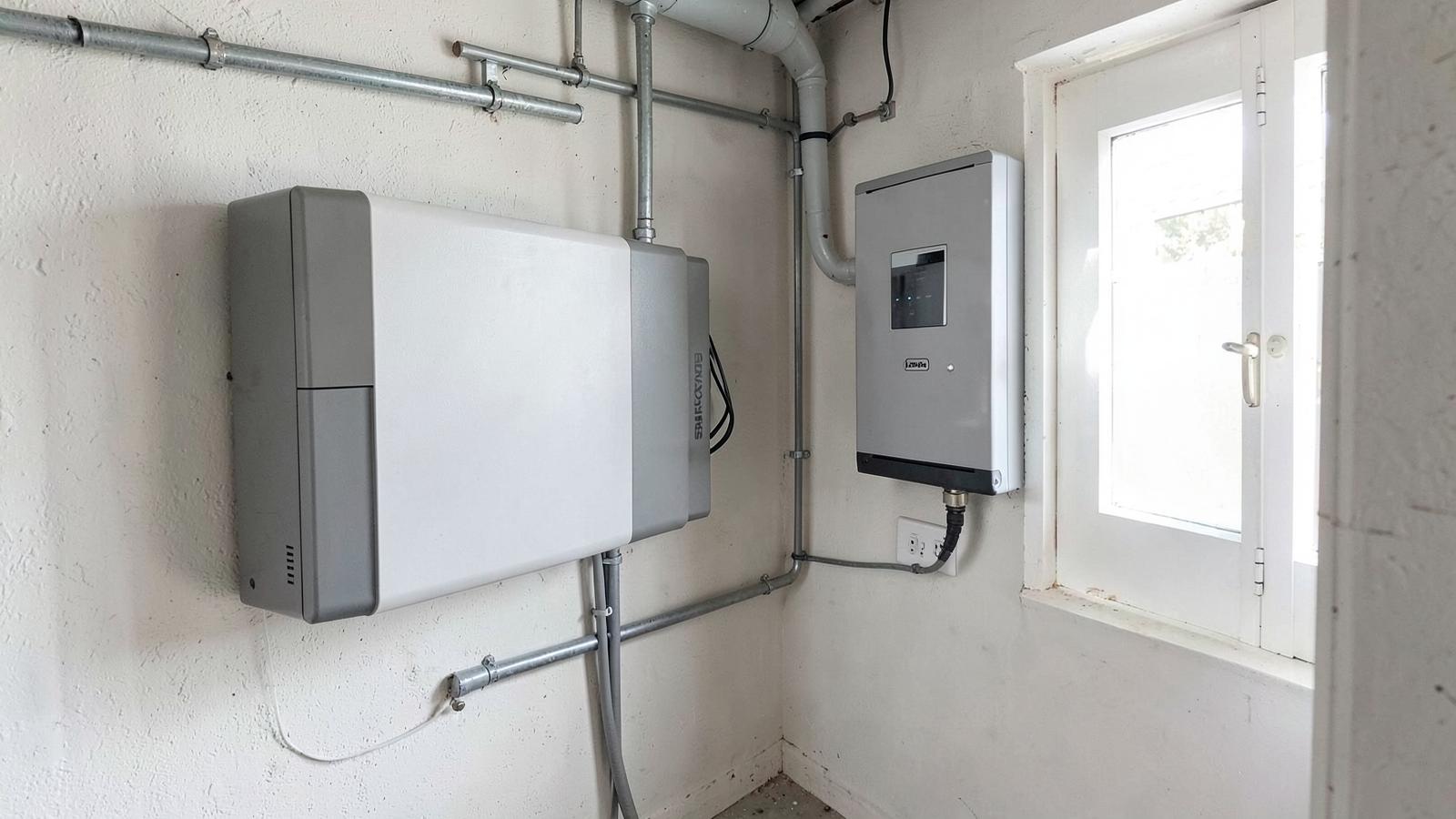
The right size is the one that regularly serves useful demand without ending most days empty too early, or full with nowhere valuable for the energy to go. To find it, compare five things: usable kWh, how much electricity you use outside solar hours, your solar surplus, the charge and discharge power in kW, and whether you need backup. The Energy Saving Trust suggests a typical home system might be around 10kWh, but is explicit that there is no universal formula — your usage decides.
Capacity and power are two different numbers
Capacity (kWh) is how much energy the battery holds. Power (kW) is how fast it can charge or discharge. A large battery with modest power output will cover a long evening of lighting, fridge and TV, but may not run an oven, kettle and immersion heater at once from storage. A high-power battery with small capacity does the opposite — strong for short bursts, empty quickly.
Both numbers need to appear on a quotation, alongside continuous versus peak output. If only capacity is quoted, ask for the rest.
A four-number sizing method
1. Total daily electricity use
Take your annual kWh from a bill and divide by 365 for a daily average, then sanity-check against a winter month and a summer month. This is the ceiling for anything a battery can do.
2. Use outside solar hours
This is the figure that actually matters. Look at what the household consumes from late afternoon through to the following morning — cooking, heating controls, lighting, appliances, EV charging if you have it. That is what the battery is being asked to cover.
3. Existing or planned solar surplus
If you already have panels, your export figures show how much generation currently leaves the property. That exported energy is the first thing a battery can capture. If solar is being installed at the same time, the design should model surplus by season rather than using an annual average.
4. Cheap-rate import opportunity
On a time-of-use tariff, the battery can also charge from the grid overnight and discharge through the expensive peak. That widens the useful size, because the battery earns even in December when solar surplus is minimal. We covered the arithmetic in is home battery storage worth it without solar.
Put the four numbers together and the sensible range usually becomes obvious — and it is a range, not a single answer.
Usable versus nominal capacity
Manufacturers quote nominal (total) capacity and usable capacity, and the difference can be meaningful. Batteries also retain a reserve so they are not driven to a genuine zero. Compare quotes on usable kWh, or you are comparing different things.
Backup is not automatic
A standard battery installation does not necessarily keep your house running in a power cut. Backup requires specific inverter capability and additional wiring, usually to a defined set of circuits rather than the whole property. If backup matters to you, say so at the survey — it changes the equipment selection and the price.
Retrofitting to existing solar
- AC-coupled batteries sit alongside an existing solar inverter and are usually the simplest retrofit.
- DC-coupled or hybrid arrangements can be more efficient but may mean replacing the existing inverter.
- The existing solar inverter's age, warranty status and monitoring all influence which route makes sense.
- Space, ventilation and ambient temperature at the proposed location need checking — garages, utility rooms and lofts are not equivalent.
Warranties, throughput and expansion
- Look for the warranty term together with the throughput or cycle limit and the end-of-warranty capacity retention figure.
- Check whether the warranty is affected by daily grid charging on a smart tariff — some are, some are not.
- Ask whether the system can be expanded later, and on what terms, if your usage changes.
- Confirm who handles a warranty claim: the installer, the distributor or the manufacturer.
Grid paperwork and export limits
Battery systems are notified to the Distribution Network Operator in the same framework as generation. Smaller installations may fall under G98 notification; most solar-plus-battery combinations need G99 approval before installation, and an export limit is a common and workable outcome. See G98 and G99 explained for the detail — we submit and manage the application as part of the job.
What a quotation must answer
- Usable capacity in kWh, and continuous and peak power in kW.
- Where the battery and inverter will be mounted, and the cable route.
- Whether backup is included, and which circuits it covers if so.
- The tariff strategy the savings estimate assumes.
- The warranty term, throughput allowance and retained capacity figure.
- Who submits the G98 or G99 notification, and whether it is included in the price.
Our approach to design and installation is on the battery storage page, indicative costs are on the pricing page, and you can book an assessment whenever you are ready.