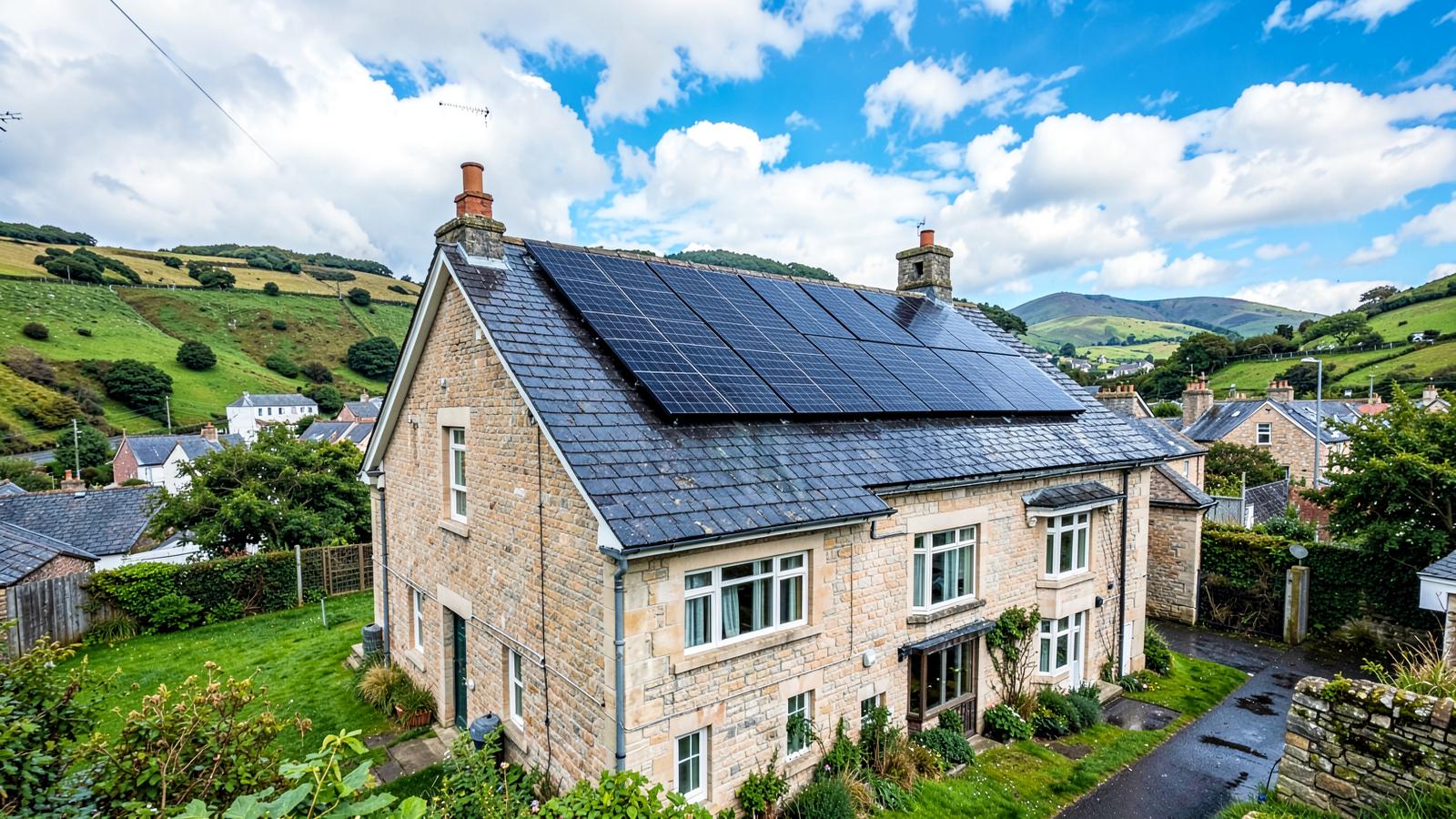
Postcode alone does not decide whether solar suits your home. What decides it is the roof — orientation, pitch, shade and structure — together with the Welsh planning and building regulations that apply to your property, and the correct connection route with National Grid Electricity Distribution, which operates the network across South Wales.
"Does it rain too much?" is the wrong test
Solar panels generate from daylight, not direct sunshine, so overcast conditions reduce output rather than stopping it. The useful question is not whether South Wales is sunny enough in general, but what your specific roof is modelled to produce across a year.
Any generation figure should come from a recognised calculation using your location, orientation, pitch and measured shading. If a quote gives you a headline number without those inputs, it is a guess dressed up as a projection.
Local roof factors that shape the design
- Natural slate is common and takes more care and time to work than concrete tile.
- Exposed hillside and coastal-edge locations mean wind loading is a real design input, not a formality.
- Valley towns often have steep terraces where a neighbouring roof line shades a lower property in winter.
- Older housing stock may need the rafters and roof covering checked before anything is fixed to them.
- Rear extensions and outbuildings sometimes offer better usable area than the main roof.
Welsh planning rules
Planning is devolved, so Welsh guidance — not English guidance — applies. Welsh Government guidance is that roof-mounted solar panels on a house are often permitted development, subject to conditions: the equipment should not be installed above the ridge line of the roof and should not project more than 200mm from the roof slope or wall surface.
- Listed buildings require planning permission and are likely to need listed building consent.
- Conservation areas and World Heritage Sites carry additional restrictions, and permitted development rights may have been removed by an Article 4 direction or a planning condition.
- Flats, maisonettes and non-domestic buildings are treated separately and need their own check.
- Your local planning authority is the definitive source for your property — ask before you order equipment.
Roof load and building regulations
Adding an array to a roof changes the loading on the structure, and the electrical work must comply with the wiring regulations. Welsh Government guidance is clear that building regulations apply to solar installations, covering structural adequacy and electrical safety. A competent installer assesses the structure as part of the survey and tells you plainly if strengthening is needed.
Grid connection: who does what
National Grid Electricity Distribution is the network operator for South Wales, and every generation or storage device has to be notified to it. Smaller installations can be notified after the fact; larger systems, and most solar-plus-battery combinations, need approval before installation. The responsibility for submitting that application should sit with your installer, and be stated in writing.
The two routes are explained in G98 and G99 explained. If an installer asks you to handle your own application, treat it as a signal about the rest of the job.
A quotation checklist
- A roof layout drawn on your actual roof planes, with obstructions and shading marked.
- System size in kWp, panel and inverter models, and whether optimisers are included.
- Annual generation from a recognised calculation, with the assumptions stated.
- Scaffolding, structural check, grid notification and MCS certification all confirmed as included or excluded.
- The workmanship warranty alongside the product warranties.
- A named point of contact and a realistic programme.
The badges to look for, and the sales tactics to walk away from, are covered in how to choose a solar installer you can actually trust. Our own approach is set out on the solar PV page, and you can talk to us about your property.